
HookMesh vs qtrl.ai
Side-by-side comparison to help you choose the right AI tool.

Elevate your SaaS with HookMesh for seamless, reliable webhook delivery and effortless customer management.
Last updated: February 28, 2026

qtrl.ai
qtrl.ai scales QA with autonomous AI agents while ensuring full team control and governance.
Last updated: March 4, 2026
Visual Comparison
HookMesh
qtrl.ai
Feature Comparison
HookMesh
Reliable Delivery
With HookMesh, businesses can rest assured that they will never lose a webhook again. The platform features automatic retries with exponential backoff and jitter, ensuring that messages are retried for up to 48 hours. This robust delivery mechanism guarantees that every webhook event is sent and received accurately, minimizing the risk of lost data.
Customer Portal
HookMesh includes an embeddable self-service portal that empowers customers to manage their webhook endpoints effectively. This intuitive interface allows users to add and configure endpoints, view detailed delivery logs, and instantly replay any failed webhooks with just one click, simplifying the overall management process.
Developer Experience
Designed with developers in mind, HookMesh enables teams to ship webhooks in mere minutes. With a REST API and official SDKs for popular languages like JavaScript, Python, and Go, integration is straightforward. Developers can quickly implement webhook events in their applications with just a few lines of code, streamlining the entire process.
At-least-once Delivery
HookMesh guarantees at-least-once delivery for every webhook event using idempotency keys. This feature ensures that even if a webhook is retried multiple times, the receiving system will not process duplicate events, providing a secure and reliable way to handle data exchanges.
qtrl.ai
Autonomous QA Agents
qtrl's intelligent agents execute high-level instructions on demand or continuously, operating within your strictly defined rules. They perform real browser execution—not mere simulations—across multiple environments at immense scale. This feature provides the power of automation with the crucial oversight that engineering teams demand, ensuring actions are predictable, reviewable, and fully aligned with your testing strategy.
Enterprise-Grade Test Management
This foundational feature provides a centralized, structured hub for all QA activities. It encompasses comprehensive test case libraries, detailed test plans, and organized test runs with full traceability from requirements to execution. Built with compliance and auditability in mind, it supports both manual and automated workflows, giving managers and leads crystal-clear visibility into coverage, status, and potential quality risks.
Progressive Automation
qtrl champions a human-in-the-loop evolution. Teams start by writing plain-English test instructions for the AI to execute. When ready, they can transition to having qtrl automatically generate and run tests based on connected requirements, with every suggestion fully reviewable and refinable. The platform proactively analyzes coverage gaps and proposes new tests, allowing automation to grow intelligently under your complete control.
Adaptive Memory & Multi-Environment Execution
The platform's Adaptive Memory builds a living, evolving knowledge base of your application by learning from every exploration, test run, and identified issue. This powers context-aware, smarter test generation over time. Coupled with robust multi-environment execution capabilities—supporting dev, staging, and prod with per-environment variables and encrypted secrets—teams can ensure consistent, secure testing across the entire development lifecycle.
Use Cases
HookMesh
E-commerce Notifications
E-commerce platforms can leverage HookMesh to send real-time notifications to customers regarding order status changes, shipping updates, and payment confirmations. This ensures that customers stay informed, enhancing their overall shopping experience and fostering trust in the platform.
SaaS Integrations
Software-as-a-Service providers can utilize HookMesh to facilitate seamless integrations with third-party applications. By managing webhook delivery efficiently, SaaS products can interact with other services, enabling features like automated data syncing and real-time updates.
Data Analytics
Businesses focused on data analytics can employ HookMesh to deliver event data to analytics platforms in real-time. This allows organizations to make data-driven decisions quickly, as they can analyze trends and user behavior without delays caused by webhook failures or mismanagement.
Incident Management
Organizations can implement HookMesh to send alerts and notifications during incidents or outages. By ensuring reliable delivery of critical messages, teams can respond promptly to issues, minimizing downtime and maintaining operational efficiency.
qtrl.ai
Scaling Beyond Manual Testing
For QA teams overwhelmed by repetitive manual test cycles, qtrl provides the transformative leap forward. It allows teams to maintain their structured, manual test management foundation while progressively introducing AI automation. They can start by having agents execute manual test instructions, then gradually shift to AI-generated test maintenance and creation, dramatically increasing coverage and speed without a disruptive, all-at-once overhaul.
Modernizing Legacy QA Workflows
Companies burdened with outdated, siloed, or script-heavy automation frameworks find a game-changing alternative in qtrl. The platform seamlessly integrates modern test management with intelligent agents, replacing brittle scripts with maintainable, English-language instructions. This breaks down legacy complexity, reduces maintenance costs, and injects adaptive intelligence into stagnant workflows, enabling a smooth transition to a contemporary QA practice.
Governing Enterprise AI Testing
Enterprises with strict compliance, audit, and security requirements can safely harness AI for QA with qtrl. Its governance-by-design philosophy ensures no black-box decisions, with full visibility into agent actions, permissioned autonomy levels, and enterprise-ready security. This allows large organizations to achieve the efficiency gains of AI-powered testing while maintaining the rigorous control, traceability, and audit trails they mandate.
Empowering Product-Led Engineering Teams
Product-led engineering teams that prioritize rapid iteration and user-centric quality can embed qtrl directly into their development lifecycle. The platform supports CI/CD integration and provides continuous quality feedback. Engineers and product managers can define high-level feature behaviors in plain English, and qtrl's agents can automatically generate and run the corresponding tests, ensuring new releases meet quality standards without slowing down the development pace.
Overview
About HookMesh
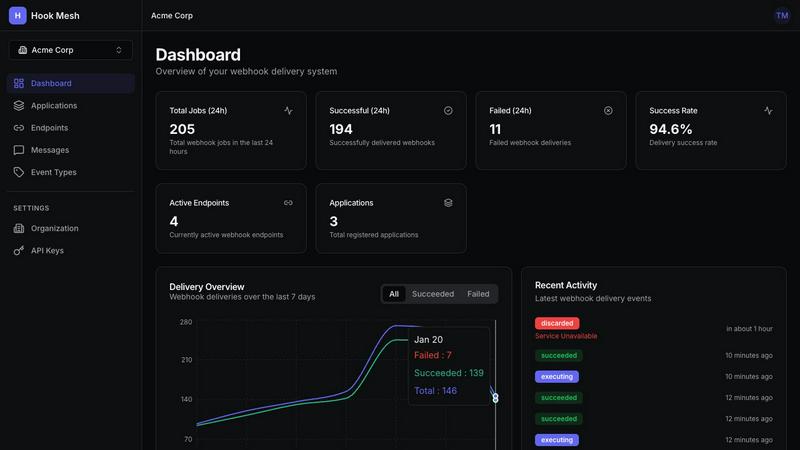
HookMesh is a revolutionary solution designed to transform the way businesses manage webhook delivery for their SaaS products. As organizations increasingly rely on webhooks to facilitate real-time data exchanges, the complexities of building and maintaining these systems in-house become evident. HookMesh alleviates these challenges by offering a comprehensive platform that handles the intricacies of webhook management, such as retry logic, circuit breakers, and debugging capabilities. This innovative tool empowers developers and product teams to focus on their core offerings without the burden of technical overhead. With battle-tested infrastructure that guarantees reliable delivery, HookMesh ensures that webhook events reach their intended destinations with precision and consistency. The platform's self-service portal provides users with seamless endpoint management and visibility, enabling them to replay failed webhooks effortlessly. By choosing HookMesh, organizations can enhance their webhook strategy, delivering peace of mind and superior customer experiences.
About qtrl.ai
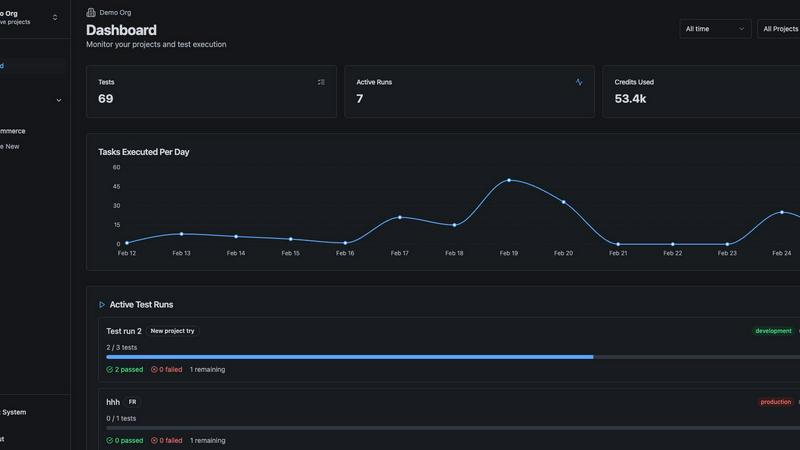
qtrl.ai is a transformative AI-powered QA platform that shatters the traditional compromise between speed and control in software testing. It is a game-changing solution designed for engineering and QA teams who are serious about scaling their quality assurance efforts without descending into the chaos of brittle automation or the unpredictability of black-box AI. qtrl provides a unified command center, merging enterprise-grade test management with intelligent, trustworthy automation. This powerful combination allows teams to meticulously organize test cases, plan and execute runs, trace requirements to coverage, and monitor quality through real-time dashboards—all from a single, governed hub.
The platform's true genius lies in its progressive approach to AI. Instead of forcing a risky, all-or-nothing adoption, qtrl introduces intelligent automation gradually and transparently. Teams begin with a solid foundation of manual test management and can confidently evolve to leverage autonomous AI agents. These agents can generate robust UI tests from simple English instructions, maintain them through application changes, and execute them at scale across any browser or environment. Built for product-led engineering teams, modernizing QA groups, and compliance-focused enterprises, qtrl.ai delivers a trusted path to faster, more intelligent quality assurance, finally bridging the gap between slow manual processes and complex, fragile automation scripts.
Frequently Asked Questions
HookMesh FAQ
What is HookMesh?
HookMesh is a webhook delivery solution that simplifies and enhances the management of webhooks for modern SaaS products. It addresses challenges like retry logic, debugging, and endpoint management, allowing businesses to focus on their core offerings.
How does HookMesh ensure reliable webhook delivery?
HookMesh employs automatic retries, exponential backoff with jitter, and circuit breakers to ensure that webhook events are delivered accurately and consistently. This robust infrastructure minimizes the risk of lost or delayed messages.
Can customers manage their own endpoints?
Yes, HookMesh features an embeddable self-service portal that allows customers to manage their webhook endpoints. Users can add and configure endpoints, view delivery logs, and replay failed webhooks with ease.
What programming languages are supported by HookMesh SDKs?
HookMesh provides official SDKs for popular programming languages, including JavaScript, Python, and Go. These SDKs streamline the integration process, enabling developers to send webhook events effortlessly.
qtrl.ai FAQ
How does qtrl.ai ensure control over the AI agents?
qtrl is built on a principle of "permissioned autonomy." You define the exact rules and boundaries within which the AI agents operate. Every action, from test generation to execution, is fully visible and reviewable in the platform. There are no hidden or black-box decisions; you maintain ultimate approval authority over what tests are created, what changes are made, and what gets executed, ensuring the AI earns trust through transparency.
Can qtrl.ai integrate with our existing development tools?
Yes, qtrl is designed for real-world workflows and offers built-in integration capabilities. It can connect with popular requirements management systems, version control, and CI/CD pipelines (like Jenkins, GitLab, GitHub Actions). This creates continuous quality feedback loops, allowing test execution to be triggered automatically by code commits or builds, and results to be fed back into your development process seamlessly.
What makes qtrl different from other "AI testing" tools?
Unlike tools that force a fully autonomous, AI-first approach which can feel risky and unpredictable, qtrl offers a progressive, trusted path. It combines robust test management with AI, allowing you to start simple and increase automation at your own pace. The focus is on augmenting human intelligence with AI assistance, not replacing it, and providing enterprise-grade governance that other tools lack.
Is my application data secure with qtrl's AI?
Absolutely. Security and data privacy are paramount. qtrl employs enterprise-ready security protocols. Crucially, for AI operations, your sensitive data like per-environment variables and encrypted secrets are never exposed to the AI agents. The system is designed to execute tests in defined environments without compromising sensitive information, ensuring your application data remains protected.
Alternatives
HookMesh Alternatives
HookMesh is a cutting-edge platform designed to streamline webhook delivery for SaaS businesses, ensuring reliable and efficient event management. As developers and product teams increasingly recognize the complexities involved in building and maintaining webhooks, many seek alternatives to optimize their operations and enhance user experience. Common motivations for exploring other options include pricing concerns, feature sets that better align with specific platform needs, and the desire for improved performance or usability. When selecting an alternative to HookMesh, it’s crucial to consider factors such as reliability, ease of use, and the availability of a self-service portal. Evaluate the delivery mechanisms offered, the transparency of the platform, and whether it provides robust support for developers. A comprehensive feature set that addresses your unique webhook management challenges will ultimately empower your team and elevate your product's performance.
qtrl.ai Alternatives
qtrl.ai is a transformative platform in the automation and dev tools space, designed to empower QA teams. It uniquely combines enterprise-grade test management with a progressive, trustworthy layer of AI agents to scale testing intelligently. This approach bridges the critical gap between manual processes and brittle traditional automation, offering a governed path to faster release cycles. Users often explore alternatives for various reasons, such as specific budget constraints, the need for different feature integrations, or platform compatibility requirements. The search for the right tool is a strategic decision to find a solution that aligns perfectly with a team's unique workflow and maturity level. When evaluating options, key considerations include the balance of AI-powered automation with human oversight, the strength of core test management capabilities, and the platform's ability to provide clear audit trails and governance. The ideal choice unlocks potential without introducing unnecessary risk or complexity.