
HookMesh vs Hostim.dev
Side-by-side comparison to help you choose the right AI tool.

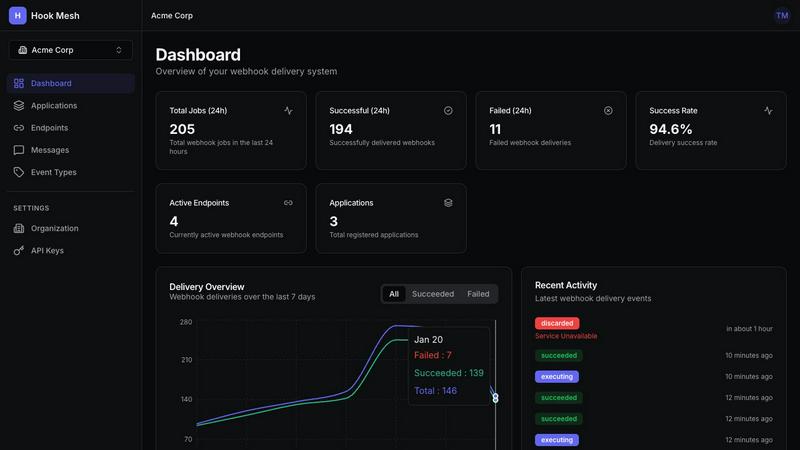
Elevate your SaaS with HookMesh for seamless, reliable webhook delivery and effortless customer management.
Last updated: February 28, 2026

Hostim.dev
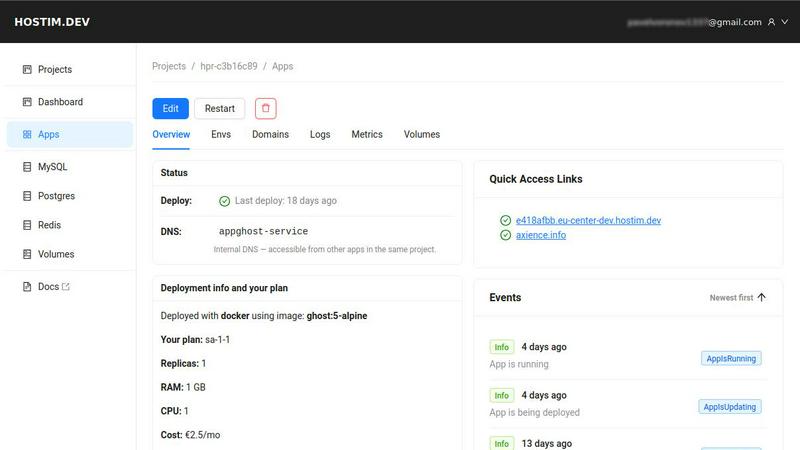
Hostim.dev transforms Docker deployment with built-in databases and predictable EU-hosted pricing.
Last updated: March 1, 2026
Visual Comparison
HookMesh
Hostim.dev
Feature Comparison
HookMesh
Reliable Delivery
With HookMesh, businesses can rest assured that they will never lose a webhook again. The platform features automatic retries with exponential backoff and jitter, ensuring that messages are retried for up to 48 hours. This robust delivery mechanism guarantees that every webhook event is sent and received accurately, minimizing the risk of lost data.
Customer Portal
HookMesh includes an embeddable self-service portal that empowers customers to manage their webhook endpoints effectively. This intuitive interface allows users to add and configure endpoints, view detailed delivery logs, and instantly replay any failed webhooks with just one click, simplifying the overall management process.
Developer Experience
Designed with developers in mind, HookMesh enables teams to ship webhooks in mere minutes. With a REST API and official SDKs for popular languages like JavaScript, Python, and Go, integration is straightforward. Developers can quickly implement webhook events in their applications with just a few lines of code, streamlining the entire process.
At-least-once Delivery
HookMesh guarantees at-least-once delivery for every webhook event using idempotency keys. This feature ensures that even if a webhook is retried multiple times, the receiving system will not process duplicate events, providing a secure and reliable way to handle data exchanges.
Hostim.dev
Effortless Deployment from Any Source
Unlock instant deployment pipelines directly from your existing workflow. Hostim.dev accepts your application as a Docker image, a Git repository for automatic builds, or a comprehensive Docker Compose file that defines your multi-service stack. This flexibility means you can deploy complex applications with databases and caches in mere minutes, completely bypassing the need to write complex Kubernetes YAML or configure CI/CD pipelines from scratch. It's the ultimate shortcut from development to a live, production-ready environment.
Built-in Managed Services & Persistent Storage
Transform your deployment experience with instantly provisioned, fully managed core services. With one click, spin up production-ready MySQL, PostgreSQL, and Redis instances that are automatically pre-wired to your application with secure environment variables. Coupled with provisioned persistent volumes for your data, this feature eradicates the time-consuming and error-prone process of manually setting up, securing, and connecting databases, giving you a complete, integrated application stack from the moment you deploy.
Secure, Isolated Projects by Default
Gain peace of mind with a security-first architecture. Every application on Hostim.dev runs within its own isolated Kubernetes namespace, ensuring complete separation of resources, networks, and data between your projects or client work. This is complemented by automatic TLS/SSL certificate provisioning for every service, ensuring HTTPS is enabled from the start. The platform provides live logs, metrics, and monitoring out of the box, creating a transparent and secure operational environment without any extra configuration.
Transparent EU Bare-Metal Hosting
Break free from opaque cloud pricing and data residency concerns. Hostim.dev runs on high-performance bare-metal servers in Germany, offering robust, GDPR-compliant hosting by default. This provides superior performance and predictability compared to virtualized cloud environments. Combined with a clear, per-project hourly billing model and cost-tracking dashboard, you get the power of premium infrastructure with the simplicity and transparency of flat, predictable pricing, starting from just €2.5 per month.
Use Cases
HookMesh
E-commerce Notifications
E-commerce platforms can leverage HookMesh to send real-time notifications to customers regarding order status changes, shipping updates, and payment confirmations. This ensures that customers stay informed, enhancing their overall shopping experience and fostering trust in the platform.
SaaS Integrations
Software-as-a-Service providers can utilize HookMesh to facilitate seamless integrations with third-party applications. By managing webhook delivery efficiently, SaaS products can interact with other services, enabling features like automated data syncing and real-time updates.
Data Analytics
Businesses focused on data analytics can employ HookMesh to deliver event data to analytics platforms in real-time. This allows organizations to make data-driven decisions quickly, as they can analyze trends and user behavior without delays caused by webhook failures or mismanagement.
Incident Management
Organizations can implement HookMesh to send alerts and notifications during incidents or outages. By ensuring reliable delivery of critical messages, teams can respond promptly to issues, minimizing downtime and maintaining operational efficiency.
Hostim.dev
Rapid Prototyping and MVP Launch for Startups
For startups racing to validate an idea, Hostim.dev is a transformative launchpad. Developers can take a backend built with Express.js, Django, FastAPI, or Spring Boot, define the stack in a Docker Compose file, and have a live, scalable MVP online in under an hour. With built-in databases and automatic HTTPS, the focus remains entirely on product development and user feedback, not on configuring servers, databases, or security policies, dramatically accelerating the path to market.
Client Project Management for Freelancers & Agencies
Agencies and freelancers can revolutionize their delivery and billing process. Each client project can be deployed as a separate, isolated environment on Hostim.dev, ensuring security and clean separation. The per-project cost tracking allows for precise, transparent billing to clients. This model simplifies handovers, as the entire application stack is managed in one simple interface, eliminating the complexity of server access and maintenance typically associated with client work.
Learning and Portfolio Building for Students
Hostim.dev unlocks real-world experience for students and aspiring developers. It provides a risk-free, professional platform to deploy full-stack applications using Docker, real databases, and modern frameworks. The free trial and student credits allow learners to move beyond localhost, building a portfolio of live, publicly accessible projects that demonstrate practical skills with industry-standard deployment tools and managed services.
Simplified SaaS Application Hosting
SaaS builders can leverage Hostim.dev to host their applications with ease and compliance. The platform's EU-based, GDPR-compliant infrastructure is ideal for serving European customers. The ability to scale CPU and RAM directly from the UI with zero downtime, coupled with the isolation per project (which can represent different tenants or application modules), provides a scalable, secure, and maintainable foundation for growing a software-as-a-service business without a dedicated DevOps team.
Overview
About HookMesh
HookMesh is a revolutionary solution designed to transform the way businesses manage webhook delivery for their SaaS products. As organizations increasingly rely on webhooks to facilitate real-time data exchanges, the complexities of building and maintaining these systems in-house become evident. HookMesh alleviates these challenges by offering a comprehensive platform that handles the intricacies of webhook management, such as retry logic, circuit breakers, and debugging capabilities. This innovative tool empowers developers and product teams to focus on their core offerings without the burden of technical overhead. With battle-tested infrastructure that guarantees reliable delivery, HookMesh ensures that webhook events reach their intended destinations with precision and consistency. The platform's self-service portal provides users with seamless endpoint management and visibility, enabling them to replay failed webhooks effortlessly. By choosing HookMesh, organizations can enhance their webhook strategy, delivering peace of mind and superior customer experiences.
About Hostim.dev
Hostim.dev is a revolutionary bare-metal Platform-as-a-Service (PaaS) that fundamentally transforms how developers deploy and manage containerized applications. It is engineered to eliminate the notorious complexity of DevOps and cloud infrastructure, unlocking unprecedented speed and simplicity. The platform empowers you to go from code to production in minutes by deploying directly from a Docker image, Git repository, or a full Docker Compose file. Hostim.dev intelligently automates the entire stack, provisioning and seamlessly wiring together essential services like MySQL, PostgreSQL, Redis, and persistent storage. Every project is secured with automatic HTTPS, lives in an isolated Kubernetes namespace for safety, and benefits from transparent, per-second billing for ultimate cost predictability. With its robust, GDPR-compliant infrastructure hosted in Germany, Hostim.dev is the game-changing solution for developers, freelancers, startups, and agencies who demand a powerful, transparent, and controlled deployment experience without the administrative nightmare.
Frequently Asked Questions
HookMesh FAQ
What is HookMesh?
HookMesh is a webhook delivery solution that simplifies and enhances the management of webhooks for modern SaaS products. It addresses challenges like retry logic, debugging, and endpoint management, allowing businesses to focus on their core offerings.
How does HookMesh ensure reliable webhook delivery?
HookMesh employs automatic retries, exponential backoff with jitter, and circuit breakers to ensure that webhook events are delivered accurately and consistently. This robust infrastructure minimizes the risk of lost or delayed messages.
Can customers manage their own endpoints?
Yes, HookMesh features an embeddable self-service portal that allows customers to manage their webhook endpoints. Users can add and configure endpoints, view delivery logs, and replay failed webhooks with ease.
What programming languages are supported by HookMesh SDKs?
HookMesh provides official SDKs for popular programming languages, including JavaScript, Python, and Go. These SDKs streamline the integration process, enabling developers to send webhook events effortlessly.
Hostim.dev FAQ
What does the free tier include?
Hostim.dev offers a generous 5-day free trial that requires no credit card for signup. This trial allows you to create a full project with all platform features, including deployment from Docker/Git/Compose, built-in services, and automatic HTTPS. It's a complete, unrestricted experience designed for you to fully test your application stack. Additionally, certain managed services like databases have their own free usage tiers, making it possible to run small projects at a very low cost.
Can I deploy with just a Docker Compose file?
Absolutely. Deploying with a Docker Compose file is a core, game-changing feature of Hostim.dev. You can simply paste your existing docker-compose.yml file into the platform's dashboard. Hostim.dev will intelligently interpret it, provision any defined services (or use its built-in managed ones), set up internal networking, and deploy your entire multi-container application stack to a live, isolated environment in minutes, with no manual infrastructure work required.
Where is my app hosted?
All applications on Hostim.dev are hosted on high-performance bare-metal servers located in secure, state-of-the-art data centers in Germany. This ensures your application benefits from the raw power of dedicated hardware while guaranteeing that all data is stored and processed within the European Union, making it inherently compliant with GDPR regulations by default—a critical advantage for businesses serving the EU market.
Do I need to know Kubernetes or DevOps?
Not at all. Hostim.dev is specifically designed to abstract away the complexity of Kubernetes and traditional DevOps. The platform uses Kubernetes under the hood to deliver robustness and isolation, but you never need to interact with it, write YAML, or understand its concepts. You manage your applications through a simple, intuitive UI or CLI, focusing solely on your code while Hostim.dev handles all the underlying infrastructure, orchestration, and operational complexities for you.
Alternatives
HookMesh Alternatives
HookMesh is a cutting-edge platform designed to streamline webhook delivery for SaaS businesses, ensuring reliable and efficient event management. As developers and product teams increasingly recognize the complexities involved in building and maintaining webhooks, many seek alternatives to optimize their operations and enhance user experience. Common motivations for exploring other options include pricing concerns, feature sets that better align with specific platform needs, and the desire for improved performance or usability. When selecting an alternative to HookMesh, it’s crucial to consider factors such as reliability, ease of use, and the availability of a self-service portal. Evaluate the delivery mechanisms offered, the transparency of the platform, and whether it provides robust support for developers. A comprehensive feature set that addresses your unique webhook management challenges will ultimately empower your team and elevate your product's performance.
Hostim.dev Alternatives
Hostim.dev is a transformative bare-metal Platform-as-a-Service (PaaS) that redefines containerized app deployment. It belongs to the category of developer-centric cloud platforms, designed to strip away DevOps complexity and unlock rapid, secure deployment directly from Docker or Git. Developers may explore alternatives for various strategic reasons. Needs evolve, and factors like specific geographic hosting requirements, budget constraints, or the need for different integrated services can prompt a search. The quest often balances simplicity against granular control, or predictable pricing against different scaling models. When evaluating other platforms, key considerations include the deployment workflow's simplicity, the transparency and structure of pricing, the robustness of built-in services like databases, and the underlying infrastructure's security and compliance standards. The goal is to find a solution that matches your project's technical demands and operational philosophy.