
CCAPI vs HookMesh
Side-by-side comparison to help you choose the right AI tool.

CCAPI
Unlock limitless AI potential with one unified API for all models and modalities.
Last updated: February 28, 2026

Elevate your SaaS with HookMesh for seamless, reliable webhook delivery and effortless customer management.
Last updated: February 28, 2026
Visual Comparison
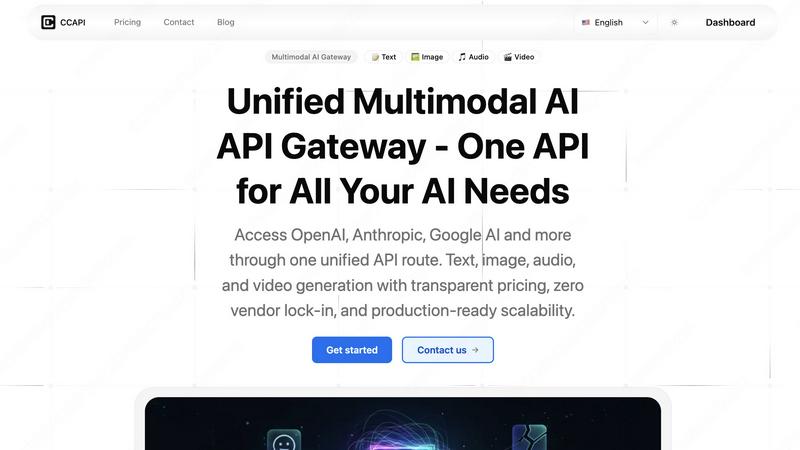
CCAPI
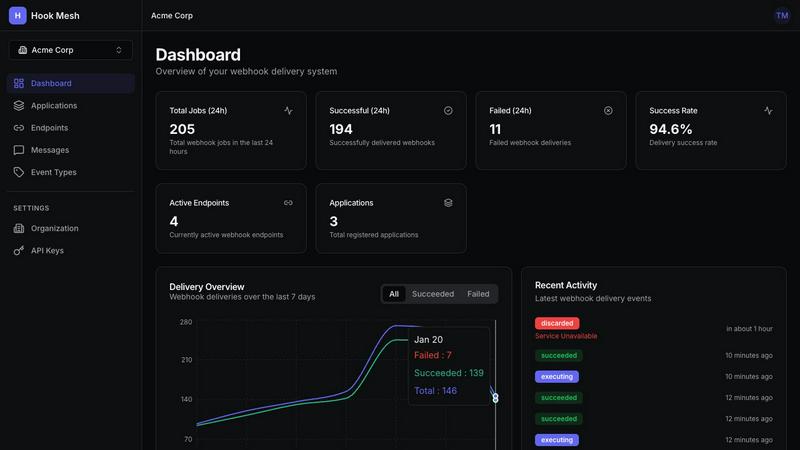
HookMesh
Feature Comparison
CCAPI
Smart Routing with Auto-Failover
This transformative feature ensures your application never loses a request. When a primary AI provider experiences downtime or high latency, CCAPI's intelligent router automatically detects the failure and switches the request to a backup provider in approximately 120 milliseconds. This multi-layer failover system operates across seven-plus providers, maintaining a near-perfect success rate and keeping your user experience seamless even during widespread API outages. You call once, and CCAPI handles the complex orchestration, providing unparalleled reliability.
Unified Multimodal API Endpoint
CCAPI unlocks the full spectrum of generative AI through one consistent, OpenAI-compatible endpoint. Developers can access top-tier models for text chat, image creation, audio synthesis, and cutting-edge video generation without learning different APIs for each provider or modality. Whether you need Claude for reasoning, Stable Diffusion for images, or Kling 3.0 for video, the same simple API structure applies. This consolidation dramatically reduces integration complexity and accelerates development cycles.
Developer-First Integration
Designed for immediate productivity, CCAPI requires virtually zero code migration. If you're already using the OpenAI SDK, you can switch by changing just one line—the base URL—to point to CCAPI's endpoint. Your existing authentication, request formats, and response handling remain intact. The platform supports all major SDKs (Python, Node.js) and any HTTP client, offering a frictionless path to a more robust and feature-rich AI infrastructure.
Transparent Usage & Custom Control
CCAPI provides a comprehensive, real-time dashboard where developers can monitor costs, latency metrics, and success rates across all models and providers. It operates on a straightforward pay-as-you-go model with real USD balances, eliminating credit gimmicks and hidden fees. Furthermore, it offers powerful customizability, allowing you to bring your own API keys and configure any OpenAI-compatible provider, giving you complete control over your AI ecosystem.
HookMesh
Reliable Delivery
With HookMesh, businesses can rest assured that they will never lose a webhook again. The platform features automatic retries with exponential backoff and jitter, ensuring that messages are retried for up to 48 hours. This robust delivery mechanism guarantees that every webhook event is sent and received accurately, minimizing the risk of lost data.
Customer Portal
HookMesh includes an embeddable self-service portal that empowers customers to manage their webhook endpoints effectively. This intuitive interface allows users to add and configure endpoints, view detailed delivery logs, and instantly replay any failed webhooks with just one click, simplifying the overall management process.
Developer Experience
Designed with developers in mind, HookMesh enables teams to ship webhooks in mere minutes. With a REST API and official SDKs for popular languages like JavaScript, Python, and Go, integration is straightforward. Developers can quickly implement webhook events in their applications with just a few lines of code, streamlining the entire process.
At-least-once Delivery
HookMesh guarantees at-least-once delivery for every webhook event using idempotency keys. This feature ensures that even if a webhook is retried multiple times, the receiving system will not process duplicate events, providing a secure and reliable way to handle data exchanges.
Use Cases
CCAPI
Building Resilient Production Applications
For startups and enterprises running customer-facing AI features, CCAPI is a game-changer. It guarantees that your chat assistant, content generator, or analysis tool remains operational 24/7, even if a major provider like OpenAI has an outage. The automatic failover ensures end-users never see an error, protecting your brand reputation and revenue by delivering consistent, uninterrupted service through a single, reliable integration.
Rapid Prototyping with Cutting-Edge Models
Developers and researchers can instantly experiment with the latest AI models without dealing with individual waitlists or approval processes. Want to compare GPT-5.2, Claude 4.6, and DeepSeek V4 for a new feature? Or test the newest video generation from Seedance 2.0? CCAPI provides immediate API access to them all through one interface, dramatically speeding up the evaluation and innovation cycle.
Cost-Optimized AI Workloads
Businesses can dynamically optimize their AI spending by leveraging CCAPI's access to a competitive marketplace of models. You can route non-critical tasks to high-value models like DeepSeek V4 for significant savings, while using premium models like Claude 4.6 for mission-critical reasoning. The unified dashboard provides clear cost analytics, enabling precise budgeting and cost control across all AI activities.
Simplifying Multi-Modal Application Development
Creating an application that needs to generate text descriptions, create matching images, and produce a voiceover is notoriously complex. CCAPI unlocks this potential by providing a single integration point for all these tasks. A developer can build a complete content creation suite using different best-in-class models for each modality, all managed through one consistent API, reducing development time and operational overhead.
HookMesh
E-commerce Notifications
E-commerce platforms can leverage HookMesh to send real-time notifications to customers regarding order status changes, shipping updates, and payment confirmations. This ensures that customers stay informed, enhancing their overall shopping experience and fostering trust in the platform.
SaaS Integrations
Software-as-a-Service providers can utilize HookMesh to facilitate seamless integrations with third-party applications. By managing webhook delivery efficiently, SaaS products can interact with other services, enabling features like automated data syncing and real-time updates.
Data Analytics
Businesses focused on data analytics can employ HookMesh to deliver event data to analytics platforms in real-time. This allows organizations to make data-driven decisions quickly, as they can analyze trends and user behavior without delays caused by webhook failures or mismanagement.
Incident Management
Organizations can implement HookMesh to send alerts and notifications during incidents or outages. By ensuring reliable delivery of critical messages, teams can respond promptly to issues, minimizing downtime and maintaining operational efficiency.
Overview
About CCAPI
CCAPI is a game-changing multimodal AI gateway that fundamentally transforms how developers and businesses access artificial intelligence. It serves as a single, unified API that aggregates the world's leading AI providers—including OpenAI, Anthropic, Google AI, DeepSeek, ByteDance, and more—under one intelligent, always-on endpoint. This revolutionary platform is built for developers who demand reliability, simplicity, and cutting-edge capability without the friction of managing multiple vendor integrations. Its core value proposition is unlocking unprecedented resilience and access: you make one API call, and CCAPI's smart routing engine handles the rest, automatically switching between providers to ensure a 99.9% success rate. It provides instant, waitlist-free access to the latest models across all four modalities—text, image, audio, and video—including new releases like Kling 3.0 and GLM-5. By offering an OpenAI-compatible endpoint, CCAPI eliminates migration headaches, allowing teams to integrate in minutes and focus on building transformative applications rather than infrastructure. It's the definitive solution for anyone looking to future-proof their AI stack, reduce costs through competitive model pricing, and guarantee their application's uptime.
About HookMesh
HookMesh is a revolutionary solution designed to transform the way businesses manage webhook delivery for their SaaS products. As organizations increasingly rely on webhooks to facilitate real-time data exchanges, the complexities of building and maintaining these systems in-house become evident. HookMesh alleviates these challenges by offering a comprehensive platform that handles the intricacies of webhook management, such as retry logic, circuit breakers, and debugging capabilities. This innovative tool empowers developers and product teams to focus on their core offerings without the burden of technical overhead. With battle-tested infrastructure that guarantees reliable delivery, HookMesh ensures that webhook events reach their intended destinations with precision and consistency. The platform's self-service portal provides users with seamless endpoint management and visibility, enabling them to replay failed webhooks effortlessly. By choosing HookMesh, organizations can enhance their webhook strategy, delivering peace of mind and superior customer experiences.
Frequently Asked Questions
CCAPI FAQ
How do I get started with CCAPI?
Getting started is designed to be instantaneous. Simply sign up for an account—you can use "Sign in with Google" for speed—and you'll receive your API key immediately with no waitlist. Then, if you're using a standard OpenAI SDK, just change your base URL to https://api.ccapi.ai/v1 and replace your API key. Your existing code will now route through CCAPI, giving you immediate access to all supported models and providers.
What happens when an AI provider is down?
This is where CCAPI's transformative smart routing shines. The system continuously monitors the health and latency of all connected providers. If your requested model's primary provider fails or times out, CCAPI's router automatically and seamlessly redirects your request to a healthy backup provider that offers a comparable model. This failover happens in about 120ms, ensuring your application's requests are completed successfully without any manual intervention required from you.
Is CCAPI compatible with my existing code?
Absolutely. CCAPI provides a fully OpenAI-compatible REST API endpoint. This means it works directly with the official OpenAI SDKs for Python and Node.js, as well as any third-party libraries or custom HTTP clients built to work with the OpenAI API format. In most cases, integration requires changing only the base URL in your configuration. Your request bodies, parameters, and response parsing logic can remain exactly the same.
Can I use my own API keys with CCAPI?
Yes, CCAPI offers advanced custom provider configuration. You can bring your own API keys from supported providers like OpenAI, Anthropic, or Google AI and add them to your CCAPI dashboard. This allows you to use CCAPI's smart routing, unified interface, and monitoring dashboard while leveraging your existing contracts or credits with those providers, giving you the best of both worlds: your rates and our resilience.
HookMesh FAQ
What is HookMesh?
HookMesh is a webhook delivery solution that simplifies and enhances the management of webhooks for modern SaaS products. It addresses challenges like retry logic, debugging, and endpoint management, allowing businesses to focus on their core offerings.
How does HookMesh ensure reliable webhook delivery?
HookMesh employs automatic retries, exponential backoff with jitter, and circuit breakers to ensure that webhook events are delivered accurately and consistently. This robust infrastructure minimizes the risk of lost or delayed messages.
Can customers manage their own endpoints?
Yes, HookMesh features an embeddable self-service portal that allows customers to manage their webhook endpoints. Users can add and configure endpoints, view delivery logs, and replay failed webhooks with ease.
What programming languages are supported by HookMesh SDKs?
HookMesh provides official SDKs for popular programming languages, including JavaScript, Python, and Go. These SDKs streamline the integration process, enabling developers to send webhook events effortlessly.
Alternatives
CCAPI Alternatives
CCAPI is a unified multimodal AI API gateway, a powerful development tool that provides a single, streamlined interface for accessing a diverse range of leading AI models. It belongs to the category of developer-centric API orchestration platforms, designed to simplify integration and unlock new potential by connecting your applications to text, image, audio, and video generation capabilities through one route. Developers often explore alternatives to find a solution that perfectly aligns with their specific project requirements. This search can be driven by factors like budget constraints, the need for specialized features not covered by a general gateway, or a desire for a platform tailored to a particular ecosystem or scale. The landscape offers various approaches, from building custom integrations to using other aggregation services. When evaluating different solutions, it's crucial to consider your core needs. Key factors include the breadth and quality of supported AI models, the simplicity and reliability of the API, the overall cost structure and transparency, and the robustness of security and compliance features. The right choice should feel like a game-changing asset that removes complexity and accelerates your development cycle.
HookMesh Alternatives
HookMesh is a cutting-edge platform designed to streamline webhook delivery for SaaS businesses, ensuring reliable and efficient event management. As developers and product teams increasingly recognize the complexities involved in building and maintaining webhooks, many seek alternatives to optimize their operations and enhance user experience. Common motivations for exploring other options include pricing concerns, feature sets that better align with specific platform needs, and the desire for improved performance or usability. When selecting an alternative to HookMesh, it’s crucial to consider factors such as reliability, ease of use, and the availability of a self-service portal. Evaluate the delivery mechanisms offered, the transparency of the platform, and whether it provides robust support for developers. A comprehensive feature set that addresses your unique webhook management challenges will ultimately empower your team and elevate your product's performance.