
Code Word Solver - Missing Words Finder vs Psychiatry Exams
Side-by-side comparison to help you choose the right AI tool.

Code Word Solver - Missing Words Finder
Unlock any codeword puzzle instantly with our powerful pattern-matching solver.
Last updated: February 28, 2026

Psychiatry Exams
Master MRCPsych effortlessly with AI-driven revisions and authentic exam questions from NHS consultants.
Last updated: March 1, 2026
Visual Comparison
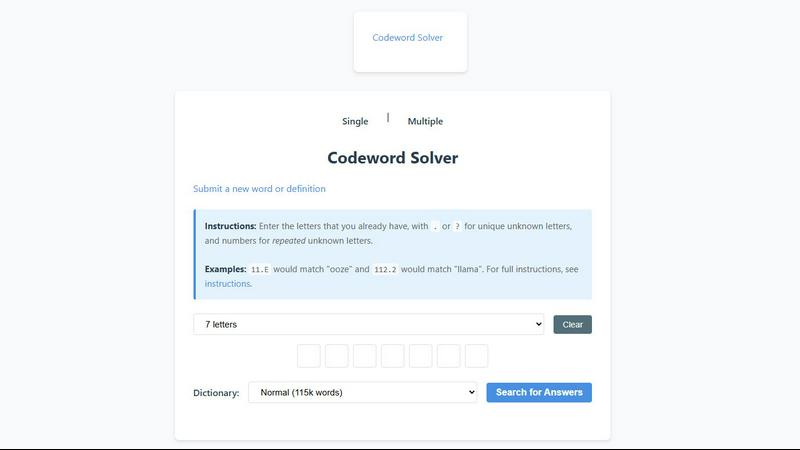
Code Word Solver - Missing Words Finder
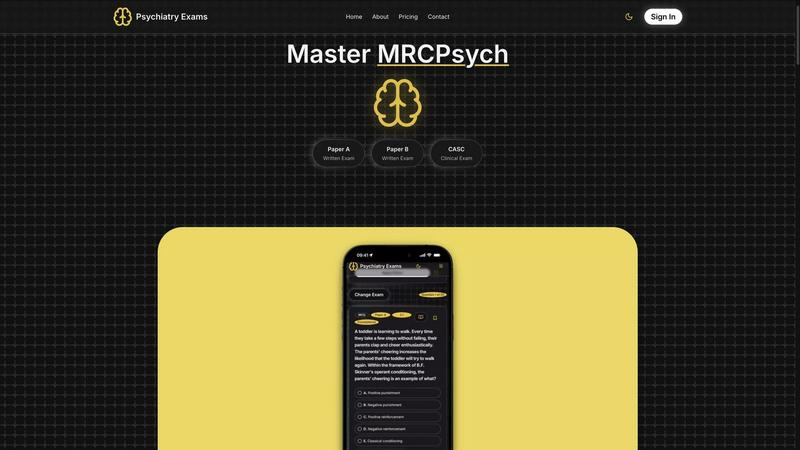
Psychiatry Exams
Feature Comparison
Code Word Solver - Missing Words Finder
Advanced Pattern Recognition Engine
This isn't just a simple wildcard search. The solver's core intelligence lies in its sophisticated pattern-matching system. You can use dots or question marks for unique unknown letters, but the real game-changer is using numbers to denote repeated unknown letters. For instance, inputting "112.2" tells the solver to find words where the first two letters are the same, the third is different, and the fourth matches the second letter—perfectly matching a word like "llama." This ensures logical consistency across the entire puzzle grid, mirroring the codeword's fundamental rule that the same number always represents the same letter.
Dual-Mode Solving Flexibility
The tool offers two transformative ways to tackle your puzzle, adapting to your specific sticking point. Use Single Pattern Solving to break down one troublesome word at a time by entering its known pattern. For more complex breakthroughs, employ Multi-Pattern Solving to input two linked word patterns simultaneously. This side-by-side analysis is incredibly powerful for cross-referencing shared number/letter relationships, allowing you to solve interconnected words and rapidly accelerate your progress through the entire puzzle grid.
Tiered Difficulty Dictionaries
Understanding that not all puzzles—or solvers—are created equal, this feature provides personalized word lists. Choose from an Easy dictionary (20k words) for common vocabulary, a Normal dictionary (115k words) for standard challenges, or a Hard dictionary (260k words) for the most obscure and demanding puzzles. This adaptive approach ensures you get relevant, accurate suggestions tailored to the specific difficulty you're facing, eliminating irrelevant clutter and focusing only on viable answers.
Community-Powered Word Database
The solver evolves with its community. If you encounter a valid word that isn't currently in the database, or you wish to add a specific definition for clarity, you can submit it directly through the tool. This collaborative feature means the word coverage continuously improves and expands over time, driven by real user experiences. It transforms a static tool into a living resource that grows smarter and more comprehensive with every puzzle solved by its community.
Psychiatry Exams
Recalled Questions
Practice with a substantial pool of 1960 recalled questions derived from real exam sittings, meticulously adapted and verified by NHS Consultants. This feature ensures that candidates engage with authentic content that reflects the actual MRCPsych exams, enhancing their readiness and familiarity with the exam format.
AI-Powered Explanations
Harness the power of advanced AI technologies such as Claude Opus 4.5, Gemini 3, and GPT 5.2 to receive in-depth explanations for each question. These AI-driven insights, combined with consultant expertise and the Royal College syllabus, provide users with a comprehensive understanding of complex psychiatric concepts and their applications.
Flashcard System
Master essential concepts through our dynamic flashcard system, designed with spaced repetition techniques to optimize long-term retention. This feature allows candidates to reinforce their knowledge effectively, ensuring they remember critical information when it matters most during the exams.
Community Engagement
Join a vibrant WhatsApp community where candidates can collaborate, share insights, and discuss various aspects of exam preparation. With dedicated discussion areas for each exam sitting, moderated by experienced consultants, this feature fosters a sense of camaraderie and support among trainees, enhancing motivation and learning.
Use Cases
Code Word Solver - Missing Words Finder
Breaking Through a Stubborn Mental Block
Every solver reaches a point where a single word halts all progress. Instead of resorting to random guesses that could derail the entire puzzle, input the known letter pattern (e.g., ".A..Y") into the Single Pattern Solver. Instantly, you'll receive a manageable list of candidate words like "DAISY" or "HAZY." This targeted assistance provides the crucial clue needed to unlock that word and, by extension, reveal new letter mappings that cascade through the rest of the grid, restarting your flow.
Solving Interconnected Word Clusters
When you have partial letters in two or more words that share common number codes, the Multi-Pattern Solver becomes indispensable. For example, if you know the patterns for a 5-letter and a 7-letter word share certain number positions, inputting both patterns together allows the tool to find word pairs that satisfy all shared relationships simultaneously. This method efficiently solves linked words that would be incredibly time-consuming to figure out in isolation, providing a strategic shortcut.
Tailoring Support to Puzzle Difficulty
Facing a gentle puzzle in a daily newspaper? Switch to the Easy dictionary for quick, common-word suggestions. Tackling a cryptic weekend puzzle known for obscure vocabulary? Select the Hard dictionary to ensure the solver considers a vast lexicon of possibilities. This use case allows you to calibrate the tool's assistance to match the challenge at hand, ensuring the help you receive is always appropriate and never gives away answers too easily on simpler puzzles.
Learning and Improving Solving Techniques
Beyond just getting an answer, the solver is an excellent educational tool. By experimenting with different pattern inputs and observing the resulting word lists, you can learn common letter patterns, word structures, and frequency distributions. Seeing how a pattern like "11.E" generates words such as "OOZE" teaches you about letter repetition and endings, actively improving your own innate codeword solving skills and pattern recognition for future puzzles.
Psychiatry Exams
Comprehensive Exam Preparation
Candidates preparing for the MRCPsych exams can utilize Psychiatry Exams as their sole resource for study materials, ensuring they have access to all necessary content in one place. This holistic approach simplifies the preparation journey, making it more efficient and less stressful.
Active Learning Enhancement
Psychiatrists in training can benefit from our unique 50:1 learning method by creating their own questions, which deepens their understanding of the material. This active engagement with the content encourages a more profound grasp of psychiatric principles and practices.
Community Support and Collaboration
Trainees can leverage the community aspect of Psychiatry Exams to connect with peers and consultants for advice, motivation, and shared experiences. This connection can be invaluable for maintaining morale and ensuring consistent study habits among candidates.
Performance Evaluation through Mock Exams
Candidates can utilize realistic mock exams to assess their readiness for the actual MRCPsych tests. These mock exams simulate the exam environment, allowing users to identify their strengths and weaknesses, which is crucial for targeted study and improvement.
Overview
About Code Word Solver - Missing Words Finder
Tired of hitting a frustrating wall in your codeword puzzle? The Code Word Solver - Missing Words Finder is your game-changing companion, designed to transform guesswork into strategic, confident solving. This powerful online tool is built specifically for codeword (or code-cracker) puzzles, where letters are replaced by numbers from 1 to 26. Its core mission is to unlock the puzzle's potential by intelligently narrowing down possible word matches based on the letter patterns you've already uncovered. Instead of staring blankly at a grid of numbers, you input what you know—using a smart pattern system—and the solver instantly provides a curated list of candidate words that fit the exact cryptographic pattern. It's built for puzzle enthusiasts of all levels, from beginners seeking a helpful nudge to seasoned solvers tackling the most challenging grids. The tool's transformative power lies in its dual-solving modes and adaptive dictionaries, empowering you to decode the grid with precision and speed, turning a daunting challenge into a satisfying and achievable victory.
About Psychiatry Exams
Psychiatry Exams is a revolutionary digital platform designed specifically for psychiatrists in training, aiming to streamline the preparation process for the MRCPsych examinations. Understanding the complexities and financial burdens associated with traditional study methods, our platform provides a comprehensive solution by consolidating all necessary resources into a user-friendly, mobile-compatible environment. We empower candidates to unlock their full potential with access to a wealth of materials, including consultant-verified question banks, innovative flashcards, and realistic mock exams. Our unique approach emphasizes active learning, allowing users to create their own questions using the 50:1 learning method, fostering deeper comprehension and retention. With a thriving, consultant-moderated community, Psychiatry Exams transforms exam preparation from a daunting task into an engaging, supportive experience, ensuring that every candidate is not just prepared, but truly confident and competent in their knowledge.
Frequently Asked Questions
Code Word Solver - Missing Words Finder FAQ
How do I enter a pattern for unknown letters?
You enter patterns using a combination of known letters, placeholders, and numbers. Use any known letters you have uncovered. For unique unknown letters (each a different letter), use a dot (.) or question mark (?). The key feature is using the same number to represent the same unknown letter. For example, the pattern "1.2.2.1" would find words where the first and last letters are identical, and the third and fourth letters are also identical to each other, like "ABBA".
What is the difference between the Easy, Normal, and Hard dictionaries?
The dictionaries differ in the size and complexity of their word lists, allowing you to match the solver's suggestions to your puzzle's difficulty. The Easy dictionary contains approximately 20,000 common words, ideal for simpler puzzles. The Normal dictionary has about 115,000 words, suitable for standard crosswords and codewords. The Hard dictionary is the most comprehensive with around 260,000 words, including obscure and less common vocabulary for the toughest challenges.
Can I use the solver for an entire puzzle at once?
The Code Word Solver is designed as a strategic aid for specific words or word pairs, not an automatic full-puzzle solver. You use it to find candidates for individual words or linked words that are blocking your progress. This approach preserves the fun and challenge of the puzzle while giving you a powerful tool to overcome specific obstacles, ensuring you remain the active solver.
What happens if the word I need isn't in the database?
The tool features a community-powered submission system. If you confirm a word is correct (e.g., from a puzzle's answer key) but it doesn't appear in the results, you can use the "Submit a new word or definition" feature. This allows you to contribute the missing word, helping to expand and improve the database for yourself and all future users.
Psychiatry Exams FAQ
What types of resources are available on Psychiatry Exams?
Psychiatry Exams offers a comprehensive suite of resources, including consultant-verified question banks, dynamic flashcards, and realistic mock exams, all tailored for MRCPsych exam preparation.
How does the AI-powered explanation feature work?
The AI-powered explanation feature provides detailed insights for each question, utilizing advanced AI technologies to enhance understanding and clarify complex psychiatric concepts, helping candidates grasp the material more effectively.
Can I contribute questions to the platform?
Yes! Users can contribute their own questions and earn AI credits for each submission. This not only benefits the community by expanding the question bank but also reinforces the contributor's learning and understanding.
Is there community support available for users?
Absolutely! Psychiatry Exams hosts a vibrant WhatsApp community where candidates can engage with peers, share study tips, and receive guidance from consultant moderators, fostering a supportive learning environment.
Alternatives
Code Word Solver - Missing Words Finder Alternatives
Code Word Solver - Missing Words Finder is a specialized digital tool designed for puzzle enthusiasts, specifically those tackling codeword or code-cracker puzzles. It belongs to the niche category of word game solvers and aids, transforming a frustrating guessing game into a logical deduction process. By analyzing letter patterns and number mappings, it provides targeted word suggestions to help users confidently complete their grids. Users often explore alternatives for various reasons. Some may seek different pricing models, such as a one-time purchase versus a subscription. Others might need specific features, like mobile app integration for on-the-go solving or a more extensive dictionary for advanced puzzles. Platform compatibility, user interface design, and the depth of solving logic are also common deciding factors. When evaluating an alternative, consider the core solver's intelligence. Does it handle complex pattern matching and repeated letters effectively? Assess the dictionary's breadth and the ability to customize word lists. Finally, look for a tool that empowers your solving journey without removing the satisfaction of the puzzle, offering clarity and control rather than just spitting out an answer.
Psychiatry Exams Alternatives
Psychiatry Exams is an innovative digital platform designed to revolutionize the preparation process for MRCPsych examinations, falling under the education and learning category. By offering a comprehensive system that combines consultant-verified recalled questions, AI-powered insights, and a dynamic learning approach, it empowers psychiatry trainees to master their exams efficiently. Users often seek alternatives to Psychiatry Exams due to factors such as pricing, specific feature sets, or the need for a platform that aligns with their individual learning styles. When exploring alternatives, it's essential to consider the quality of content, the availability of up-to-date resources, ease of use, and the level of community support that can enhance the learning experience.