
Interactive Circle of Fifths vs PseudoRun
Side-by-side comparison to help you choose the right AI tool.

Interactive Circle of Fifths
Master music theory and unlock creative potential with this interactive Circle of Fifths tool.
Last updated: March 1, 2026

PseudoRun
PseudoRun is the premier free online platform for mastering IGCSE pseudocode with real-time validation and practice.
Last updated: March 1, 2026
Visual Comparison
Interactive Circle of Fifths
PseudoRun
Feature Comparison
Interactive Circle of Fifths
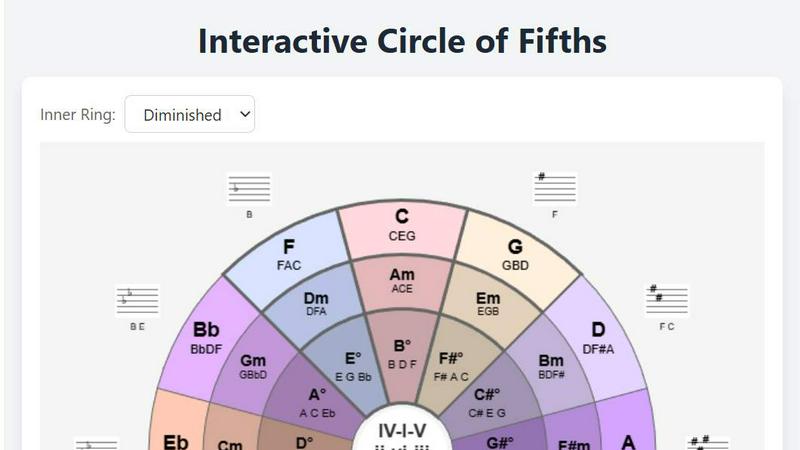
Dynamic Circle & Scale Selection
This is the core interactive engine of the tool. Users can select any key as the root, and the entire circle dynamically updates to show all related chords and scales. The inner ring allows for instant selection between essential scales like Pentatonic, Blues, Diatonic, and Diminished, transforming the displayed notes and harmonies in real-time. This feature provides a holistic, visual map of music theory, making complex relationships between keys and modes immediately comprehensible and explorable.
Harmonized Scale & Chord Sequencer Panel
This panel displays the complete harmonized scale for the selected key (e.g., C, Dm, Em, F, G, Am, B°), alongside their Roman numeral functions (I, ii, iii, IV, V, vi, vii°). It acts as an intelligent chord sequencer, allowing users to build and audition progressions by clicking on chords. This transforms abstract theory into a hands-on composition and experimentation lab, revealing why certain chords work together and how they create musical tension and resolution.
Integrated Piano & Guitar Visualizers
This game-changing feature directly links theory to instrument mastery. When a chord or scale is selected, dedicated visual overlays for piano and guitar display the exact fingerings and positions on the fretboard and keyboard. This allows musicians to learn shapes, practice fingerings, and apply theoretical concepts in real-time, dramatically accelerating the journey from understanding a concept to physically executing it on their instrument.
Functional Analysis & Resolution Guide
Going beyond simple display, this feature provides deep analytical insights. For any selected chord, the tool shows its "Scale Degree" and suggests what it "Resolves To," based on classical and contemporary harmonic function. This empowers users to understand the directional flow of music, craft more compelling progressions, and improvise with purpose by knowing which notes and chords will create the desired musical effect, moving from random notes to intentional storytelling.
PseudoRun
IGCSE Exam Focused
PseudoRun is meticulously aligned with the Cambridge IGCSE Computer Science pseudocode specifications and exam patterns. This ensures that students are not only learning effectively but also preparing optimally for their exams. The platform's focus on IGCSE content provides users with confidence and clarity as they tackle their studies.
Real-Time Validation
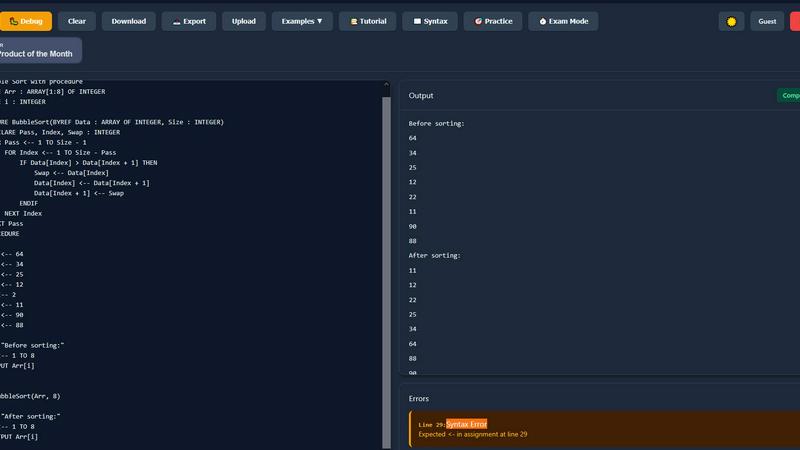
One of the standout features of PseudoRun is its real-time validation system. As users write their pseudocode, the platform instantly checks for syntax errors and provides immediate feedback. This capability allows learners to correct mistakes on the spot, fostering a deeper understanding of correct coding practices and improving their overall coding skills.
Step-by-Step Debugger
The step-by-step debugger in PseudoRun is a powerful tool for enhancing learning. It enables users to execute their pseudocode line-by-line, tracking variable changes along the way. This feature demystifies complex algorithms, allowing students to visualize how their code works in real-time and reinforcing their grasp of programming logic.
Free Cloud Storage
With PseudoRun, users can save an unlimited number of pseudocode programs directly to the cloud. This feature allows students to access their work from any device, ensuring that they can continue their practice and review their progress anytime, anywhere. This flexibility is essential for effective exam preparation.
Use Cases
Interactive Circle of Fifths
Accelerated Music Theory Learning
For students and beginners, this tool demystifies music theory. Instead of memorizing static charts, learners interact with a living model of harmony. They can click through keys, hear chord qualities, and see scale constructions visually, turning abstract concepts into tangible, auditory experiences. This interactive approach leads to faster comprehension and longer-lasting retention of fundamental principles.
Songwriting & Chord Progression Crafting
Songwriters and composers can break through creative blocks by using the tool as an idea generator. The Harmonized Scale panel and Chord Sequencer allow for instant experimentation with diatonic and non-diatonic progressions. By auditioning different chord resolutions and exploring modal interchange via the circle, writers can discover unique and emotionally resonant harmonic pathways for their songs.
Instrument-Specific Skill Development
Guitarists and pianists can use the visualizers for targeted practice. A guitarist can explore the pentatonic scale in a new key and immediately see all box positions on the neck. A pianist can study the voicings of a complex diminished chord. This bridges the gap between knowing a scale's notes and mastering its physical execution across the entire instrument, enhancing technical fluency.
Improvisation & Solo Construction
Improvisers can plan and practice solos with theoretical confidence. By selecting a backing chord progression, a musician can see which scales (e.g., Blues over a I-IV-V) are applicable. The visualizers then show the precise notes and patterns to use over each chord, enabling the musician to craft solos that are both melodically interesting and harmonically sound, moving from simple noodling to meaningful musical statements.
PseudoRun
Exam Preparation
Students can utilize PseudoRun to prepare for their IGCSE Computer Science exams effectively. The platform's alignment with exam specifications, coupled with its practice problems, allows learners to focus on the topics that matter most, enhancing their readiness for exam day.
Learning Algorithm Concepts
Educators can use PseudoRun as a teaching aid to illustrate algorithm concepts in a clear and engaging manner. By encouraging students to experiment with pseudocode, teachers can facilitate deeper understanding and retention of algorithm principles, making lessons more impactful.
Debugging Practice
PseudoRun serves as an excellent environment for students to hone their debugging skills. The step-by-step execution and variable tracking features allow learners to experiment with their code, understand errors, and develop problem-solving strategies crucial for programming success.
Collaborative Learning
PseudoRun can be used in group settings where students collaborate on pseudocode projects. This fosters teamwork, encourages discussion around coding concepts, and helps students learn from one another, making the learning experience more enriching and comprehensive.
Overview
About Interactive Circle of Fifths
The Interactive Circle of Fifths is a revolutionary and game-changing musical tool designed to transform the way musicians of all levels understand and apply music theory. It is far more than a static diagram; it is a dynamic, visual, and auditory platform that unlocks the intricate relationships between chords, scales, and keys. This tool empowers beginners to grasp foundational concepts with ease while providing advanced musicians with deep, practical insights for composition and improvisation. Its core value proposition lies in making complex theoretical relationships intuitive through interactive exploration. By visualizing the harmonized scale of any key, users can instantly see and hear chord progressions, understand scale degrees, and discover how chords resolve. With integrated piano and guitar visualizers, theoretical knowledge is directly translated to the fretboard and keyboard, accelerating skill development. Whether you're deciphering song structures, writing your own music, or aiming to improvise with confidence, the Interactive Circle of Fifths is the transformative resource that bridges the gap between abstract theory and practical, creative application, truly unlocking your full musical potential.
About PseudoRun
PseudoRun is a groundbreaking online platform designed to transform the learning experience for students and educators in the realm of pseudocode and algorithms. Tailored specifically for beginners and those preparing for the Cambridge IGCSE Computer Science exams, it offers an interactive space where users can write, run, and test their pseudocode in real-time. PseudoRun eliminates the distractions often found in traditional programming environments, allowing learners to focus solely on mastering core concepts. With features such as instant feedback, step-by-step debugging, and a clean interface, PseudoRun empowers users to explore their creativity, debug ideas, and solidify their understanding of programming fundamentals. The platform is designed to bridge the gap between theory and practical application, making it an invaluable resource for anyone looking to excel in IGCSE Computer Science. With PseudoRun, students can confidently approach their studies, knowing they have the ultimate tool at their fingertips for mastering pseudocode.
Frequently Asked Questions
Interactive Circle of Fifths FAQ
Who is the Interactive Circle of Fifths for?
This tool is designed for any musician seeking to deepen their understanding and application of music theory, regardless of primary instrument or skill level. It is transformative for beginners needing a clear visual guide, invaluable for intermediate players aiming to understand chord progressions and improvisation, and a powerful reference for advanced composers and educators for analysis and teaching.
How does it help with learning guitar or piano?
The integrated Piano and Guitar Visualizers are key. When you select a chord or scale, the tool displays the exact fingerings and positions on a diagram of your instrument's fretboard or keyboard. This allows you to directly connect the theoretical concept you are learning (e.g., a G Major chord) to the physical shape you need to play, accelerating muscle memory and practical application.
Can I use it to write songs in any key?
Absolutely. The tool's core functionality is key-agnostic. You can select any root note as your starting point, and the entire circle, harmonized scale, and chord functions will instantly transpose. This allows you to experiment with progressions in your vocal range or explore the sonic color of different keys, making songwriting flexible and informed.
What is the "Resolves To" function and how do I use it?
The "Resolves To" indicator teaches you about harmonic tension and release, a fundamental force in music. It shows the typical chord(s) that follow the one you have selected, based on established music theory. Composers use this to create satisfying progressions, while improvisers use it to target notes that will sound consonant over changing chords, greatly enhancing musical coherence.
PseudoRun FAQ
How does PseudoRun help with IGCSE exam preparation?
PseudoRun is specifically designed to align with the Cambridge IGCSE Computer Science pseudocode specifications, offering practice problems and features that prepare students effectively for their exams.
Is PseudoRun free to use?
Yes, PseudoRun is completely free to use. There are no hidden fees or premium features, allowing all students to access all tools and resources without any financial barriers.
Can I access my work from multiple devices?
Absolutely! PseudoRun offers free cloud storage that allows users to save their pseudocode programs and access them from any device, ensuring seamless learning and practice.
Does PseudoRun provide support for debugging?
Yes, PseudoRun features a powerful step-by-step debugger that allows users to execute their pseudocode line-by-line, track variable changes, and debug their code effectively. This feature enhances the learning process and builds stronger programming skills.
Alternatives
Interactive Circle of Fifths Alternatives
The Interactive Circle of Fifths is a transformative educational tool designed to revolutionize how musicians understand music theory. It belongs to the category of interactive music education software, providing a dynamic, visual, and auditory platform for mastering scales, chords, and their intricate relationships. Users often explore alternatives for various reasons, including different budget considerations, the need for specific features not covered, or compatibility with particular devices and operating systems. Some may seek a simpler interface, while others look for more advanced compositional tools or different instrument focus. When evaluating other options, it's crucial to consider your primary learning goals. Look for tools that effectively bridge theory and practice, offer clear visualizations, and provide instrument-specific guidance. The right alternative should feel like a game-changing partner in your musical journey, unlocking your potential by making complex concepts accessible and immediately applicable.
PseudoRun Alternatives
PseudoRun is a groundbreaking pseudocode platform specifically designed for IGCSE students and educators, allowing users to write, test, and master algorithms effortlessly. This innovative tool has gained popularity for its focus on enhancing the learning experience through real-time feedback and a distraction-free interface. However, users often seek alternatives due to various reasons such as pricing, specific feature sets, or compatibility with different learning styles and platforms. When looking for alternatives, it is essential to consider factors such as alignment with educational standards, user interface simplicity, interactive capabilities, and community support. The right alternative should not only offer comparable features but also cater to individual learning needs, making the journey of mastering algorithms as engaging and effective as possible.