
conceptviz vs LLMWise
Side-by-side comparison to help you choose the right AI tool.

conceptviz
ConceptViz transforms complex ideas into clear, science-ready diagrams for any educational level.
Last updated: February 28, 2026

LLMWise
LLMWise offers a single API for accessing top AI models, optimizing prompts with smart auto-routing to maximize value.
Last updated: February 28, 2026
Visual Comparison
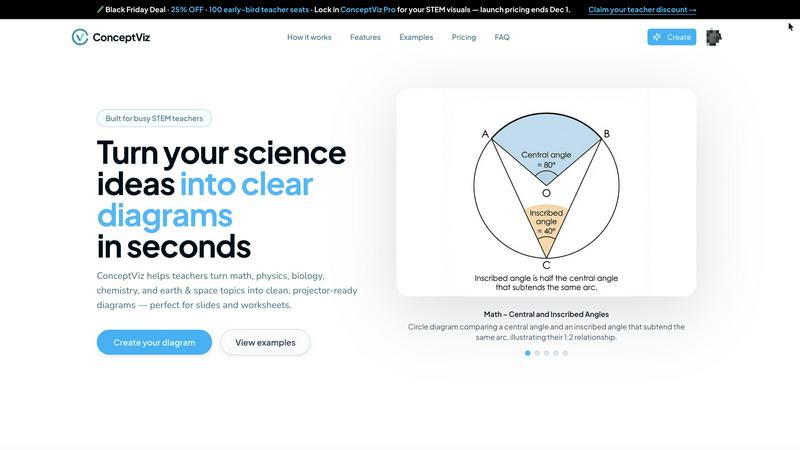
conceptviz
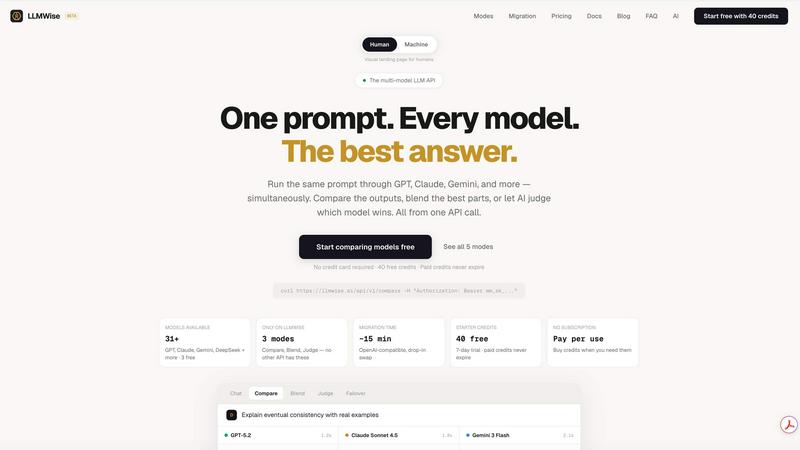
LLMWise
Feature Comparison
conceptviz
Subject & Grade Presets
ConceptViz is built with real classrooms in mind, offering quick-start presets for core STEM subjects including Physics, Biology, Chemistry, Earth & Space, and Math. These presets are intelligently tuned to align with U.S. grade bands, from elementary to high school, ensuring the generated diagrams are age-appropriate and conceptually accurate. This feature removes all guesswork, allowing educators to generate perfectly tailored visuals without any prior design or drawing expertise, making sophisticated diagram creation accessible to everyone.
Projector-Ready Clarity
Every diagram generated by ConceptViz is optimized for real-world teaching environments. The platform prioritizes practical details that matter most in a classroom: thick, legible lines and labels, simple backgrounds with minimal visual noise, and high-contrast color schemes. This intentional design guarantees that diagrams remain sharp and comprehensible from the front row to the back, even on lower-resolution classroom projectors, ensuring every student can follow along with ease.
Slide & Worksheet Friendly Output
ConceptViz diagrams are engineered for seamless integration into your existing workflow. They are automatically generated in a widescreen aspect ratio perfect for PowerPoint and Google Slides, and are available with clean white or light backgrounds ideal for printing on worksheets. Users can download high-resolution PNG files and instantly paste them directly into their teaching materials, saving countless hours normally spent on formatting and resizing found images.
Plain-English Description to Diagram
The core transformative feature of ConceptViz is its ability to turn a simple, plain-English description into a detailed scientific diagram. Users just need to type what they need, such as "labeled plant cell cross-section for 8th grade" or "convex lens ray diagram." The AI interprets the request and generates a clean, accurate visual. This allows educators to create diagrams that match their exact teaching narrative, fostering consistency and enabling the reuse of prompts across different classes and sections.
LLMWise
Smart Routing
LLMWise's smart routing feature intelligently directs prompts to the optimal model based on the task at hand. This means that coding queries go to GPT, creative writing tasks are sent to Claude, and translation requests are managed by Gemini. This targeted approach ensures that users receive the most accurate and contextually relevant responses, enhancing the overall effectiveness of their applications.
Compare & Blend
With the compare and blend functionality, users can run prompts across different models side-by-side. This feature allows for a direct comparison of responses, enabling developers to identify the best outputs. The blend option takes it a step further by synthesizing the most effective parts of each model's response into a single, stronger answer, maximizing quality and insight.
Always Resilient
Reliability is at the core of LLMWise. The always resilient feature includes a circuit-breaker failover mechanism that automatically reroutes requests to backup models in case a primary provider experiences downtime. This ensures that applications remain functional without interruption, providing a seamless user experience and peace of mind for developers.
Test & Optimize
LLMWise offers robust testing and optimization tools, including benchmark suites, batch tests, and optimization policies focused on speed, cost, or reliability. Automated regression checks ensure that the performance of integrated models remains consistent over time, allowing developers to fine-tune their applications effectively and efficiently.
Use Cases
conceptviz
Enhancing K-12 Lesson Plans
Elementary, middle, and high school STEM teachers can use ConceptViz to rapidly create custom diagrams for daily lesson plans, worksheets, and interactive whiteboard presentations. Instead of scouring the internet for "almost right" images, a teacher can generate a precise diagram on-demand, such as a "states of matter particle model" for elementary science or a "block on incline free body diagram" for high school physics, ensuring the visual perfectly aligns with the day's learning objective.
Accelerating Academic Research & Publishing
Graduate students, PhD candidates, and academic researchers can leverage ConceptViz to produce precise, publication-ready figures for theses, journal papers, and conference posters. The tool's ability to generate accurate schematics for complex concepts—like an acid-base titration setup or a mitosis stage sequence—streamlines the research communication process, allowing scholars to focus on their analysis rather than struggling with graphic design software.
Creating Differentiated Learning Materials
Educators can use ConceptViz to easily create multiple versions of a diagram to support differentiated instruction. For instance, a biology teacher could generate a simple animal cell diagram for some students and a more detailed, organelle-rich version for others, all from slightly adjusted text prompts. This enables personalized learning at scale, ensuring all students have access to visuals that match their comprehension level.
Supporting Student Projects and Study Aids
Students at all levels can use ConceptViz to create their own study guides, project visuals, and presentation materials. A student struggling to visualize central vs. inscribed angles in geometry can generate a clear diagram to study from. Similarly, a group working on a science fair project about potential and kinetic energy can quickly produce professional-looking visuals to enhance their display and explanation.
LLMWise
Efficient Development
Developers can leverage LLMWise to streamline their workflow by utilizing the best AI model for each specific task. For instance, when creating applications that require different functionalities, such as coding, content creation, and translations, LLMWise ensures that the right model is used for optimal results, significantly reducing development time.
Enhanced Quality Control
Quality assurance teams can utilize the compare mode to verify outputs from various models on the same prompts. This allows them to assess which model performs best for their specific needs, ensuring that only the most accurate and relevant information is utilized in their projects.
Cost-Effective AI Solutions
Startups and small businesses can benefit from LLMWise by eliminating the need for multiple AI subscriptions. With one API that provides access to a multitude of models, companies can drastically reduce their expenses while still accessing high-quality AI capabilities, all while paying only for what they use.
Prototyping and Testing
LLMWise is ideal for rapid prototyping, allowing developers to test their applications with 30 free models at zero cost. This enables teams to experiment and iterate quickly without financial constraints, ultimately speeding up the development cycle and fostering innovation.
Overview
About conceptviz
ConceptViz is a revolutionary AI-powered diagramming tool that is fundamentally transforming the landscape of STEM education and research. It is engineered to unlock the potential of educators, students, and researchers by instantly converting intricate scientific and mathematical concepts into crystal-clear, visually engaging diagrams. This game-changing platform eliminates the traditional barriers of time, design skill, and resource availability, empowering users to generate classroom-ready, publication-quality visuals in mere seconds with a simple text description. From K-12 teachers crafting dynamic lesson plans and worksheets to university students and researchers needing precise figures for theses and presentations, ConceptViz caters to a wide spectrum of needs. Its core value proposition lies in delivering projector-ready clarity, curriculum-aligned accuracy, and unprecedented time savings, ensuring that the focus remains on explanation and discovery rather than on tedious graphic creation. By making complex ideas accessible and visually stimulating, ConceptViz is not just a tool; it's a transformative force in democratizing high-quality scientific visualization.
About LLMWise
LLMWise revolutionizes the way developers interact with large language models (LLMs) by providing a single API that connects to all major models, including OpenAI, Anthropic, Google, Meta, xAI, and DeepSeek. This innovative platform eliminates the hassle of managing multiple AI providers and allows users to leverage the best model for each specific task. With intelligent routing capabilities, LLMWise automatically directs prompts to the most suitable model—whether that be GPT for coding, Claude for creative writing, or Gemini for translation. This seamless integration not only enhances productivity but also optimizes performance through features like side-by-side comparisons, output blending, and model evaluations. LLMWise is designed for developers who seek efficiency and effectiveness without the complexity of juggling multiple subscriptions. The platform empowers users to focus on what truly matters: harnessing the potential of AI to transform their applications and workflows.
Frequently Asked Questions
conceptviz FAQ
Do I need any design skills to use ConceptViz?
Absolutely not. ConceptViz is specifically designed for educators and researchers, not graphic designers. The entire process is driven by simple, plain-English text descriptions. You just describe the scientific diagram you need, and the AI handles all the complex drawing, labeling, and layout work, delivering a polished, classroom-ready visual in seconds without any design expertise required.
What subjects and grade levels does ConceptViz support?
ConceptViz supports a comprehensive range of STEM subjects, including Physics, Biology, Chemistry, Earth & Space, and Mathematics. It is built with grade-level appropriateness in mind, offering presets and tuning for U.S. grade bands from elementary school through to high school and even university-level research topics, making it a versatile tool for the entire educational journey.
Can I use the diagrams in printed worksheets and slides?
Yes, this is a core strength of ConceptViz. All diagrams are generated to be immediately useful in real teaching scenarios. They are provided in high-resolution PNG format with clean backgrounds, optimized for both digital use (in PowerPoint, Google Slides) and physical printing on worksheets and handouts. The widescreen aspect ratio and clear labeling ensure they look professional in any medium.
Is there a free trial available?
Yes, you can start using ConceptViz for free without a credit card. The free tier allows you to generate diagrams, including in 4K Ultra HD quality, so you can fully experience how the platform transforms your lesson preparation and research workflow before committing to a paid plan.
LLMWise FAQ
How does LLMWise determine the optimal model for a prompt?
LLMWise uses intelligent routing algorithms that analyze the nature of the prompt and direct it to the model best suited for that specific task. This ensures that users receive the highest quality output based on the context.
Can I use my existing API keys with LLMWise?
Yes, LLMWise supports a bring-your-own-key (BYOK) feature that allows users to integrate their existing API keys into the platform. This flexibility enables cost savings while maintaining access to the models you already use.
What happens if a model provider goes down?
LLMWise features a circuit-breaker failover mechanism that automatically reroutes requests to backup models if a primary provider is unavailable. This ensures that your applications remain operational without any interruptions.
Are there any subscription fees associated with LLMWise?
LLMWise operates on a pay-as-you-go model with no monthly subscriptions. Users only pay for the credits they consume, making it a cost-effective solution for accessing advanced AI capabilities without the burden of recurring fees.
Alternatives
conceptviz Alternatives
ConceptViz is a transformative AI-powered design tool that specializes in creating clear, science-ready diagrams from complex concepts. It belongs to the dynamic categories of AI assistants, content creation, and data visualization, specifically engineered to empower STEM education and research. This platform is a game-changer for educators and students seeking to unlock visual understanding without design expertise. Users often explore alternatives for various reasons, such as budget constraints, specific feature requirements not covered, or the need for integration with other platforms like learning management systems. Some may seek tools with different output formats, more advanced customization, or a broader focus beyond STEM-specific diagramming. When evaluating an alternative, consider your core need: is it rapid, AI-driven generation, subject-specific accuracy, or classroom-ready simplicity? Assess the tool's ease of use, the quality and resolution of its outputs, and how well its presets or customization align with your educational level and subject matter. The right choice should seamlessly fit into your workflow, enhancing clarity without adding complexity.
LLMWise Alternatives
LLMWise is a cutting-edge solution that provides a unified API to access various leading language models, including GPT, Claude, and Gemini. This innovative platform belongs to the AI Assistants category, designed to streamline the process of utilizing multiple AI providers by intelligently routing prompts to the most suitable model. Users often seek alternatives to LLMWise due to considerations like pricing, feature sets, or specific platform requirements that better align with their unique needs. When searching for an alternative, it’s crucial to evaluate the flexibility of the API, the diversity of models available, and the ease of integration into existing systems. Additionally, consider the cost structures, support for testing and optimization, and failover capabilities to ensure that the solution can adapt to varying demands without sacrificing performance.