Google TurboQuant
Google TurboQuant revolutionizes KV cache compression for LLM inference, achieving 6x memory reduction with zero accuracy loss.
AI tool Details
Explore More
Alternatives
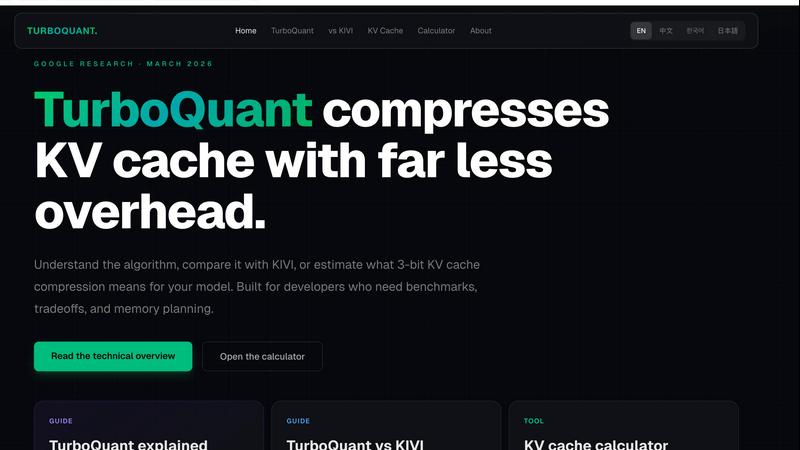
About Google TurboQuant
Google TurboQuant is an advanced KV cache compression method developed by Google Research, specifically designed for optimizing large language model (LLM) inference. This innovative solution employs a unique two-stage approach, combining PolarQuant and a 1-bit QJL residual correction, to achieve remarkable memory efficiency. By compressing KV cache to just 3 bits per channel, TurboQuant maintains near-lossless accuracy while significantly reducing memory usage, enabling users to deploy more demanding models without the typical resource constraints. This groundbreaking technology is ideal for researchers, developers, and organizations looking to enhance the performance of LLMs, particularly in scenarios requiring long-context processing and high-speed attention mechanisms. TurboQuant not only addresses the critical bottleneck of KV cache memory but also provides substantial speed improvements, making it a vital tool in the evolving landscape of AI.
Features
Two-Stage Compression Pipeline
TurboQuant utilizes a sophisticated two-stage compression pipeline that first applies PolarQuant to rotate input vectors into polar coordinates, followed by scalar quantization. This dual-step process captures significant compression with minimal computational overhead, ensuring efficient resource utilization.
Near-Lossless 3-Bit Quantization
With TurboQuant, users can achieve KV cache compression down to 3 bits per channel without sacrificing accuracy. This near-lossless quantization is backed by rigorous benchmarks, demonstrating that users can maintain performance across various applications while dramatically reducing memory requirements.
Enhanced Attention Speed
TurboQuant provides up to 8 times faster attention computation on NVIDIA H100 GPUs in 4-bit mode. This speedup is crucial for applications demanding real-time performance, allowing models to process longer contexts and larger datasets rapidly and efficiently.
Compatibility with Various Model Architectures
TurboQuant is designed to work seamlessly with different LLM architectures, including MHA, GQA, and MQA models. This flexibility ensures that users can integrate TurboQuant into their existing workflows and achieve optimal performance regardless of their specific use case or hardware configuration.
Use Cases
Long-Context Processing
TurboQuant excels in scenarios that require processing long contexts, such as document summarization or contextual understanding in chatbots. By reducing the KV cache memory footprint, it allows models to handle larger context windows without overwhelming GPU resources.
High-Performance AI Applications
Organizations developing AI applications that demand high throughput can leverage TurboQuant to enhance their systems' performance. The significant memory savings and speed improvements facilitate the use of more complex models in production environments.
Research and Development
Researchers exploring cutting-edge AI methodologies will find TurboQuant invaluable for conducting experiments with large models while managing computational costs. Its efficient memory usage enables more extensive experimentation without compromising on model complexity or performance.
Vector Search Workloads
TurboQuant’s KV cache compression extends its utility to vector search workloads, where precision and speed are paramount. By optimizing memory usage and accelerating attention mechanisms, TurboQuant enhances the efficacy of search algorithms in retrieving relevant information swiftly.
Frequently Asked Questions
What is KV cache compression in TurboQuant?
KV cache compression in TurboQuant refers to the method of reducing the memory used for storing attention keys and values in LLM inference. This technique employs advanced quantization strategies to minimize memory usage while preserving model accuracy.
How does TurboQuant compare to KIVI?
TurboQuant outperforms KIVI in benchmark tests, providing higher LongBench composite scores at equivalent bit budgets. This makes TurboQuant a superior choice for those seeking optimal performance from their LLMs.
What hardware is recommended for using TurboQuant?
While TurboQuant can be implemented on various hardware platforms, optimal performance is observed on NVIDIA H100 GPUs, where significant speedups in attention computation can be achieved, especially in 4-bit mode.
Is any training required to implement TurboQuant?
No, TurboQuant is designed to be data-oblivious and can be applied directly during the inference stage. This means users can integrate TurboQuant without needing additional training, streamlining the deployment process.
Similar to Google TurboQuant

AUTOMATER.ai
A tray helper for every AI coding tool: one searchable library of past sessions, waiting alerts and usage across 9 providers.

Luminus Tools
A fast, privacy-first suite of online calculators, financial desks, health trackers, and developer uutilities running completely in your browser witho

JevModel
Run Choice, Score and Noul decisions on text or JSON. Build visual flows, process batches and integrate results through an API.

GetYouTubeTranscript
Free YouTube transcripts on the web, a Chrome extension, and an API + MCP server so AI assistants can read YouTube.

layahost
Moderation, routing, intent and scoring for any text over one Jev-compatible API, hosted in the EU.