AI tool Details
Explore More
Alternatives
About act101
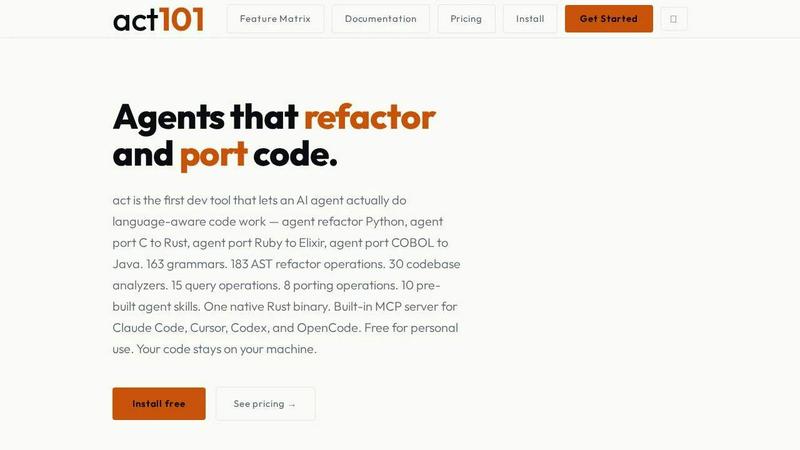
act101 is a revolutionary, game-changing dev tool that fundamentally transforms how AI agents interact with source code. It is the first tool ever created that allows an AI agent to actually perform language-aware code refactoring and porting across an astonishing 163 programming languages. This is not just another code assistant; it is a paradigm shift in software engineering. Built as a native Rust binary, act101 operates as a Model Context Protocol (MCP) server, seamlessly integrating with leading AI coding agents like Claude Code, Cursor, Codex, and OpenCode. Its core value proposition is unlocking the full potential of AI to execute complex, structural code transformations that were previously impossible without human intervention. With 183 AST refactor operations, 30 codebase analyzers, and 8 porting operations, act101 empowers developers and teams to modernize legacy systems, enforce architectural standards, and accelerate development cycles with unprecedented precision and safety. Your code remains entirely on your machine, with no indexing, no caching, and no telemetry, ensuring complete privacy and security. This tool is a game-changer for any developer, architect, or engineering leader looking to harness the true power of AI for tangible, high-stakes code work.
Features
183 AST-Aware Refactor Operations
This feature is a transformative leap in AI-driven code manipulation. act101 provides AI agents with a typed, comprehensive library of 183 Abstract Syntax Tree (AST) aware refactoring operations. This includes powerful actions like extract-function, rename across a workspace, move-symbol with automatic import updates, inline, convert-to-dataclass, and extract-trait. Unlike traditional whole-file rewrites that break formatting and lose comments, these operations are precise, cross-file consistent, and maintain the integrity of your code. Every operation is automatically checkpointed, providing instant undo capability, which unlocks a new level of confidence and safety for AI-driven development.
8 End-to-End Porting Operations
act101 delivers a game-changing capability for cross-language migration through a sophisticated state machine. It provides 8 dedicated porting operations: port_contract, port_inventory, port_order, and a port_manifest state machine (with init, add, update, remove, note states). This structured approach allows an AI agent to systematically anchor a source-to-target migration, enumerate every symbol that must move, resolve dependency ordering, and track progress step by step. This unlocks the potential to port complex codebases from C to Rust, Ruby to Elixir, or COBOL to Java with a level of automation and reliability that was previously unattainable.
30 Comprehensive Codebase Analyzers
This feature is a powerful tool for unlocking deep structural insights into any codebase. act101 equips AI agents with 30 distinct analyzers that perform sophisticated analyses, including coupling, cycles, chokepoints, hotspots, dead code detection, layers, seams, clusters, fan balance, migration readiness, and type completeness. Before an agent touches a single line of code, it can generate a complete structural map of the repository. This capability transforms the agent from a blind editor into a strategic architect, enabling it to make informed decisions, identify high-impact areas, and execute complex engineering workflows with surgical precision.
10 Pre-Built Agent Skills
act101 provides a transformative suite of 10 pre-built, composable agent skills that turn individual operations into powerful, high-level engineering workflows. These skills include architecture-audit, code-review, refactoring, code-navigation, code-generation, migration-assessment, boundary-analysis, change-impact, health-check, and architectural-refactoring. By invoking a skill with a simple command like /skill-name, developers can unlock complex, multi-step processes that were previously time-consuming and error-prone. This feature dramatically accelerates common tasks, allowing developers to focus on higher-level strategic decisions while the AI agent handles the heavy lifting.
Use Cases
Modernizing Legacy Codebases
This use case is a game-changer for enterprises burdened with legacy systems. act101 enables an AI agent to systematically analyze a monolithic, outdated codebase in a language like COBOL or C. Using the porting operations, the agent can create a contract for migration to a modern language like Java or Rust, inventory all symbols, resolve dependencies, and execute the transformation step-by-step. Simultaneously, the refactoring operations can be used to break down monolithic structures into microservices, rename confusing symbols, and add type hints, all while maintaining a perfect audit trail and the ability to undo any change instantly. This unlocks the potential to revitalize critical business systems without the traditional risk and cost.
Enforcing Architectural Standards Across a Codebase
act101 empowers engineering leaders to enforce a consistent, high-quality architecture across their entire codebase. An AI agent can use the 30 analyzers to identify violations of architectural boundaries, detect unwanted coupling between modules, and pinpoint cyclic dependencies. Then, using the move-symbol and extract-module refactoring operations, the agent can autonomously restructure the code to comply with the desired architecture. This unlocks a proactive approach to code health, preventing technical debt from accumulating and ensuring that the codebase remains maintainable and scalable over time. This is a transformative capability for any growing engineering organization.
Accelerating Code Review with Deep Analysis
This use case transforms the code review process from a superficial check into a deep, structural audit. By invoking the code-review or architecture-audit skill, an AI agent can analyze a pull request not just for syntax errors, but for deeper issues like high coupling, low cohesion, and potential bottlenecks. The agent can provide a summary of the change's impact, identify dead code that might be introduced, and even suggest specific refactoring operations to improve the code's design. This unlocks a new standard for code quality, freeing human reviewers from tedious checks and allowing them to focus on high-level logic and business context.
Performing Safe, Large-Scale Refactoring
act101 unlocks the ability to perform massive, cross-cutting refactoring projects that were previously too risky to attempt. An AI agent can be tasked with renaming a core domain concept across a multi-language monorepo, or extracting a shared library from duplicated code in hundreds of files. Using the AST-aware operations, the agent ensures every reference is updated correctly, every import is adjusted, and no comment or formatting is lost. The automatic checkpointing on every operation provides a safety net, allowing the developer to review the changes and instantly undo any part of the process. This unlocks a new era of fearless code evolution.
Frequently Asked Questions
How does act101 ensure the safety of my code during AI agent operations?
act101 prioritizes safety through several transformative mechanisms. Every single AST-aware refactor operation is automatically checkpointed before execution, allowing for instant undo if the result is not satisfactory. Unlike whole-file rewrites that can destroy formatting and comments, these operations are precise and surgical, preserving the integrity of your code. Furthermore, your code never leaves your machine; there is no indexing, caching, or telemetry. This combination of precise operations, instant rollback, and local execution unlocks a new level of trust and safety in AI-driven code manipulation.
What is the performance advantage of using act101 over file-based operations?
act101 delivers a game-changing performance advantage by operating on the Abstract Syntax Tree (AST) rather than raw text files. This approach uses approximately 85% fewer tokens than traditional file-based operations, as benchmarks have shown. Because it parses code on demand with no indexing or caching, there is no cold start penalty and results are never stale. The tool is built as a single native Rust binary, which is incredibly fast and has no plugin runtime or package graph, eliminating supply-chain attack surfaces and unlocking blazing-fast execution for even the largest codebases.
Can act101 work with my existing AI coding tools and workflow?
Yes, act101 is designed for seamless integration with your existing workflow. It is built as a Model Context Protocol (MCP) server, which is the standard for AI agent tool integration. It works out of the box with leading AI coding agents like Claude Code, Cursor, Windsurf, Codex, and OpenCode. This unlocks the ability to supercharge your current AI tools with powerful, language-aware capabilities without requiring you to change your preferred development environment. You simply install the binary and configure your agent to connect to the built-in MCP server.
How many programming languages does act101 support, and is there a list?
act101 supports an incredible 163 programming languages within a single binary. This comprehensive support covers nearly every language a developer might encounter, from mainstream languages like Python, Rust, TypeScript, Go, and Java to legacy languages like COBOL and niche or domain-specific languages. This unlocks the potential to work across polyglot codebases and perform cross-language porting between any two of the supported grammars. The specific list of all 163 grammars is available in the product's documentation.
Similar to act101

Product Launch Checklist
A free launch checklist for SaaS, apps, AI tools and more. Every step says why it matters and when you can skip it.

layahost
Moderation, routing, intent and scoring for any text over one Jev-compatible API, hosted in the EU.

laya.tools
A free directory of 950+ projects built on Laya, the open-source decision model. Updated daily.
Sprite Sheet Maker
A free browser-based toolkit for creating, cutting, converting, and previewing sprite sheet animations.

Forms Plugin
The #1 Native Form Builder Plugin for Framer - No Code, No Embeds, No External Platforms.